

By Michael Grass
Center for an Informed Public
University of Washington
Shawn Lee, a teacher at Seattle’s Ballard High School, has long been a strong supporter of the University of Washington Center for an Informed Public’s educational work. He’s not only brought his students to the first Misinfo Day at UW Seattle in 2019 and in subsequent years, he’s also used his classroom to test out new models for teaching media literacy skills developed at the CIP, including intergenerational learning events and escape room style game activities.
Lee was also part of the CIP Community Fellowship’s 2024-25 cohort where he partnered with Scott DeJong, a visiting Fulbright Scholar from Canada’s Concordia University, to develop and test out The Feed: A Game of Social Media Mischief, a new educational card game for high school students that explores the various motivations and incentives around sharing social media content. Their collaboration is a great example of how pairing insights from academic research and professional practice can lead to deeper community connection and novel approaches to media literacy education.
We recently sat down with DeJong and Lee to discuss The Feed and their recent CIP collaboration around educational gaming development.
Center for an Informed Public: Scott, can you explain what The Feed is, how it developed and how the game works?
 Scott DeJong: The Feed is a card game designed with high school teachers to create classroom conversations on how content moves around social media. Built from research, including my dissertation work, the game has students play as online actors (trolls, conspiracy theorists, influencers, content farms) and use tactics (like distorting the truth or spreading memes) to gain likes and followers that they use to gain influence and win.
It was developed over the course of 9 months as part of my time as a Fulbright scholar at the CIP. Shawn and I met in October and I shared my work with him, his goals for a game with me, and we worked together on various prototypes to make something usable in his class. At the start it was us and random students I could get together to test the game. In time we tested it with other teachers and Shawn got feedback from his students on the game.
We went through various iterations learning about the balance of complexity, the learning goals versus making it fun, and thinking about how to make it usable in Shawn’s class and beyond. Academically, we might say this game is designed through research creation where we used research to inform the game’s design. The game does not tell players what to think or do, but invites them to explore social media and see the motivations and tactics behind the creation and distribution of content. It generates discussion with players about the content they come across and shows them, through play, the systems behind them. To help teachers unpack this we are finalizing 5 lesson plans to go with the game.
Critically, we wanted to make sure that the game is usable in classrooms. So it is playable in 30 minutes, cheap to print/use, and is scaffolded for teaching to groups of 20+ individuals. It was modeled off my research on existing information literacy games, directly designing in the spaces that are lost. The game allows players to write their own social media use into it, where each player provides a community at the start of the game that they are a part of, and has mechanics that encourage them to explain what the content they are posting is about. All of this helps ground the game to their lives and generate conversation.
CIP: Shawn, how did you use The Feed in your classroom? What did you learn from your students’ experiences playing it?
Shawn Lee: I used The Feed to frame a unit on information literacy, which included materials created, collected, and curated by Teachers for an Informed Public, the Co-Designing for Trust group, and the CIP’s MisinfoDay team. Through the game, students learned how collective conversations on social media can quickly become complicated, convoluted, and spiral out of control — something many of them have observed firsthand online.
CIP: Why do you think educational gaming activities are a good way to approach complex informational challenges that students are encountering online and in their lives?
 DeJong: Games are not the only way to do this, but they inherently engage, model, and have mechanics that are already showing how false information works. Analog games specifically are really good at showing how a system works by having players enact the rules rather than have a computer hide its rules behind the interface. In The Feed players actively post content to other player’s communities and talk about what the content was about. It drives conversation, reaction, and responses from other players. For example, the game has four types of content — outrage, satire, conspiracy, and cute. Numerous times I have posted outrage to a player’s community only to have them post outrage back, and we go back and forth in what we might call a “flame war.”
So, to your question, educational games help us (1) understand a system by looking at its model and (2) engage us in an experience that, with proper facilitation, we can recognize in our own lives, and (3) keep us at arms length to reality so we can be more likely to express thoughts or ideas (i.e., it is just a game). To point 3, research on games and roleplay talk of the alibi, where people by playing as a character are more likely to do things they might not as themselves because of the alibi. They will say, do, or even ask questions they might be hesitant to outside of that.
On that note, games are engaging, and when they model a system we build a literacy (knowledge needed to play it) that can actively model the tactics and strategies of online engagement. For example, players might realize that they can target certain communities because they are more vulnerable to certain content, or that cute content is really good at getting engagement because it appears harmless. Games are powerful tools for expression and interaction – sometimes we simplify this to fun. Critically, in the case of information manipulation, we can actually view it as a game in many ways. When people are manipulating information they are being tactical. They are thinking about what to say, what not to say, and how to twist a message all to achieve a particular goal. There is a game behind a lie, a game behind the way we present information to an audience and that game has an objective. Sometimes the goal might be manipulation, other times it could just be getting them to see your perspective, but when we do that especially online it gets caught up in systems that offer particular affordances or mechanics for how we can express and share that information. Understanding that is hard. Understanding these motivations can be challenging to disentangle. But a game can help do that by removing lots of the fluff, showing a particular angle, and letting our play explore it.
CIP: The CIP is a research center not only known for fostering multidisciplinary collaboration among researchers but also working with community practitioners to better inform and apply our work and expertise. Can you share some observations from your experiences collaborating with our CIP community during the course of your work?
DeJong: A core part of my research has always been about making tools that can and will be used by the audiences that they are meant for. I pitched the Fulbright with the intent of working with local communities and Shawn happened to be the first to connect with me. I did spend time with librarians as well as community centers and even talking with some non-profits. So to see this many academia-adjacent groups all coalescing around the CIP was extremely refreshing. It shaped the work I was doing in the moment but also gave me goals for the future as I continue to build a career in this space.
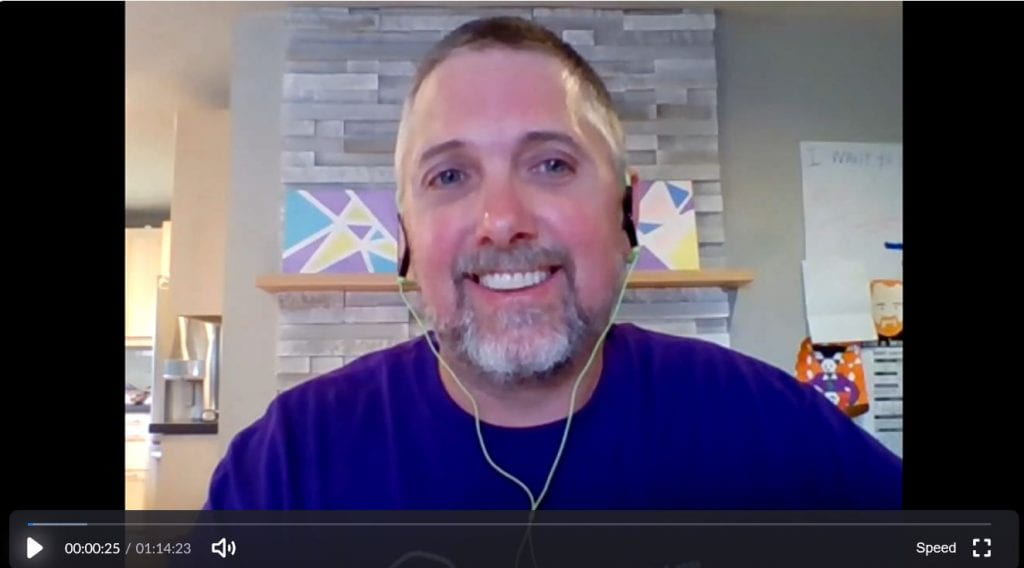
Above: Ballard High School teacher Shawn Lee during a MisinfoDay Jr. webinar in 2020.
CIP: Shawn, you’ve been engaged with the CIP’s educational programs for more than 5 years through your classroom work at Ballard High School. You’ve participated in MisinfoDay and previously piloted intergenerational learning events around media literacy skills. With your Community Fellowship work wrapping up, what insights and experiences will be sticking with you going forward in your work?
Lee: One key insight from my Community Fellowship experience is the importance of maintaining focus. Today’s information environment is vast, fast-moving, and complex, with numerous challenges to address. It’s essential to focus less on the technology itself and more on the behaviors technology encourages in people. Having a partner like Scott, who helped us focus on creating a game that authentically simulates online experiences, was invaluable. Scott, [Information School professor and UW Game Research Group member] Jin Ha Lee and the CIP team provided access to research and insights about how technology shapes people’s understanding of the world. For example, the game tactics players use mirror the “Dismiss, Distract, Dismay, and Distort” strategies that disinformationists use to promote their agenda. Scott’s deep understanding of game mechanics was central to bringing this project to life — something that wouldn’t have been possible without the Community Fellowship.
CIP: Scott, what was your experience pursuing your Fulbright Scholarship work at the University of Washington?
DeJong: My Fulbright experience at the University of Washington was deeply formative for my work and the level of scholarship I could achieve. The CIP was full of researchers engaging in similar questions as me, so in many ways I felt at home. I could have discussions that avoided covering the basics, but getting to the depth of these complex issues tied to our information environments. Concordia, my home university, has been great at allowing me to be creative and the UW Information School accepted my design-based work with open arms. The reception from students and professors was incredible, and the support I got from people whether through conversations, playtesting, or feedback was wonderful to get — not to mention the campus is also gorgeous.
It was an interesting time overall. Working with disinformation and AI researchers and teachers during an American election and AI boom had me engaging in conversations that were actively being shaped and shaping the world around them. Seeing the responsiveness of scholarly work to the issues and moments happening was refreshing to my own goals of wanting research to be active, engaged and rapid.
CIP: Anything else you want to share about this work and your collaboration?
DeJong: This is key. We were able to obtain support from foundry10 for the game to help us finalize its production. They are helping us do a first print run where we can give the first 500-1000 copies away for free to anyone who asks. They just need to fill out this form. The game is meant to be used and we are doing everything we can to make it available to the public.
Finally, as a researcher I want to emphasize that without connecting my work to the audiences that will use it, the work loses immense value. Working with Shawn was incredible and we formed a partnership that will continue beyond the Fulbright where we presented together at the PAX gaming conference and will be doing promotion for the game and improving it for the next year and more.
Lee: This year, I hope to promote and distribute the games to teachers throughout Washington state. Scott connected us with angel investors at foundry10, who are printing several hundred copies of the game. Our goal is for The Feed to become part of the MisinfoDay game series, played alongside other escape room style games developed at the CIP, including the Euphorigen Investigation and Galaxy.
Michael Grass is the Center for an Informed Public’s assistant director for communications.

